Why Great Photography Starts with Intentional Composition

Strong photographs guide the viewer’s attention with a clear arrangement of subjects, shapes, and empty space. That arrangement begins before you press the shutter.
Intentional composition asks you to notice what belongs in the frame, what should stay outside it, and how each element supports the photograph’s main idea. The process applies equally to film and digital photography, and it can make even an ordinary setting feel purposeful.
Move Past the Standard Rule of Thirds
The rule of thirds gives beginners a useful starting point: divide the frame into nine equal sections and place key elements near the intersecting lines. Yet a grid can’t decide what your photograph needs. So,a centered portrait may create calm symmetry, even though it doesn’t follow the rule.
Experiment by making three versions of the same scene. Use the grid for the first, center the main subject for the second, and fill the third with strong negative space. Compare the results without judging them by a single formula. Ask where your eye lands first, how it travels through each image, and which arrangement best reflects the moment.
Study Diverse Perspectives Worldwide
Looking closely at other photographers’ work expands your visual vocabulary. Explore images from different regions, climates, and cultural settings, paying attention to how creators organize space and use familiar elements in unexpected ways. An online gallery such as Lumenira can help you discover photography from creators worldwide and compare a broad range of visual approaches.
Study one image at a time for at least 30 seconds. Identify the brightest area, the dominant shape, and the point where your attention settles. Then consider camera height and distance. A street photographed from ground level communicates something different from the same street viewed through an upper window. Borrow the underlying idea, such as layering foreground objects, without trying to reproduce the image itself.

Find Natural Framing Elements
Doorways, windows, branches, and patches of shadow can create a boundary around your subject. These natural frames reduce visual clutter and establish depth, especially when the foreground appears slightly darker or softer than the main scene.
This technique connects with Gestalt principles of visual perception, which explain how viewers group shapes and interpret relationships within an image. Look around the edges of your viewfinder before taking a photograph. A doorway may provide balanced vertical lines, while an arch can echo the curve of a person’s posture.
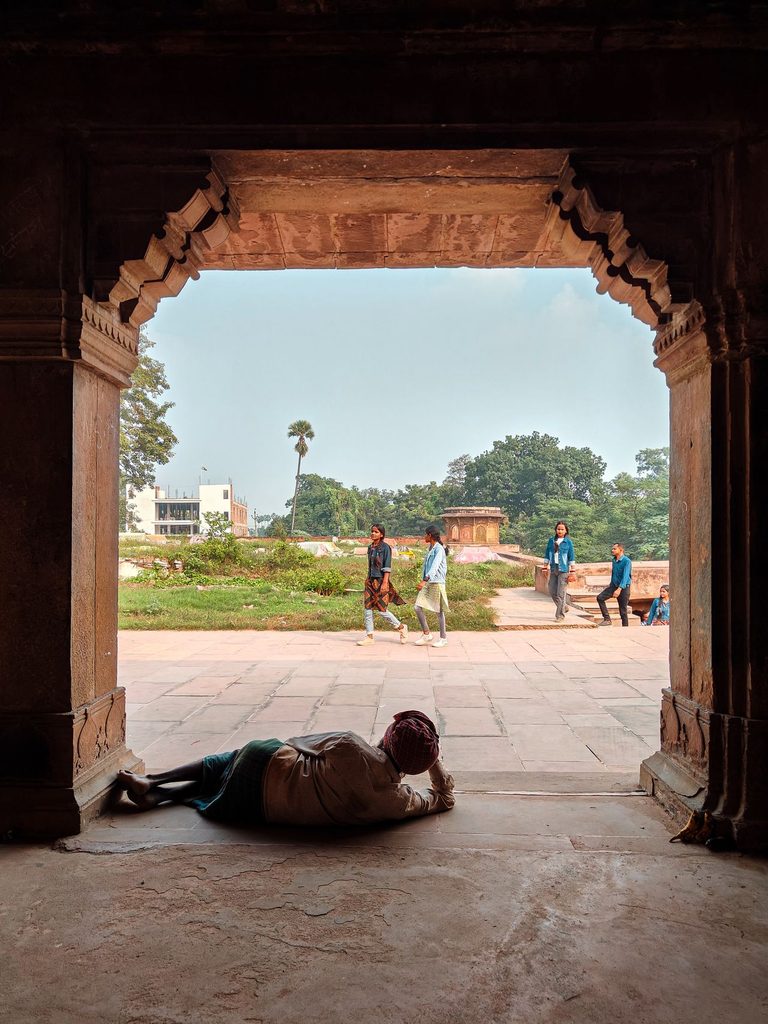
Keep the frame supportive. If it becomes brighter, sharper, or more colorful than the subject, shift your position a few inches or change your angle until the visual hierarchy feels clear.
Train Your Eye for Quiet Details
Memorable compositions often come from small relationships: two matching colors across a room, a reflection broken by ripples, or a hand entering a patch of light. Train yourself to spot these details by limiting each practice session to one visual theme.

Spend 20 minutes photographing only repeated shapes, shadows, or color pairs. A narrow assignment reduces the pressure to find a grand subject and helps you see patterns that usually disappear into the background. Review the photographs later and examine their edges. Stray signs, clipped objects, and bright corners can pull attention away from the intended subject.
Pause for one final scan before every exposure. Move from corner to corner, check the background and decide whether each visible element earns its place. That short habit turns composition into a deliberate choice instead of a correction made during editing.
Just taking one step sideways or waiting for a distracting figure to pass can make all the difference. Give the scene a few extra seconds, then release the shutter when its lines, light, and small details begin working together.